Time for a good ol’ “is Sci-Fi right?” post. We’ve been talking a lot about AI lately with a touch of paleontology, so let’s jump back to the couch and look at some “space nonsense.” For this, we’re focusing on two distinct flavors of science fiction: the legendary Star Trek, and Andy Weir’s fantastic novel (and now Ryan Gosling blockbuster) Project Hail Mary. Please note that this post is more for lesson building and detailed explanations.
An interactive calculator is live here:
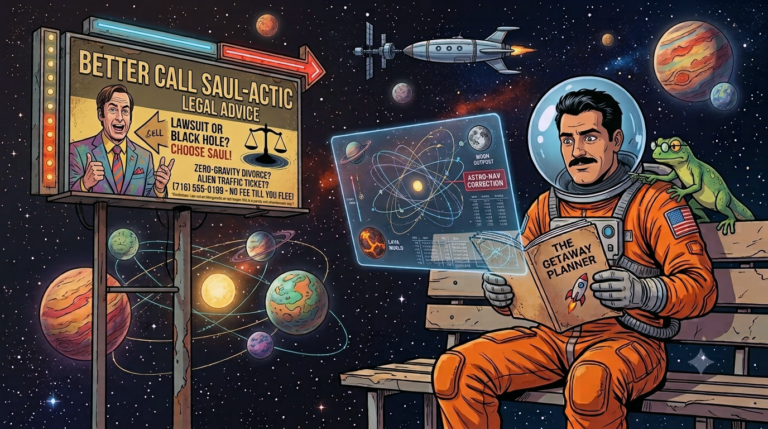
The Getaway Planner
Star Trek: Bubbles, Not Wormholes
In Star Trek, they use an anti-matter/matter reaction to power a “Warp Drive.” The common misconception is that this is like a wormhole or causes time dilation.
Actually, the Warp Drive is designed to avoid Einstein’s “Twin Paradox.” In real physics, if you fly near the speed of light, time slows down for you permanently—there is no “snap back.” You’d return to Earth to find your friends long dead. Star Trek avoids this by creating a Warp Bubble that moves space around the ship. Because the ship itself isn’t technically moving through space faster than light (the space itself is moving), the crew stays in sync with “Federation Standard Time.”
Verdict: Pure fiction for now, but it’s the only way to have a galactic government without everyone being born in different centuries!
How We Actually Move: The Hohmann Transfer
The way we get to other planets right now is via the Hohmann Transfer Orbit. It is the “economy class” of space travel.
Instead of flying in a straight line, we burn our engines to enter an elliptical orbit that eventually meets the target planet. It’s highly efficient but incredibly slow. Once you’re in orbit, you’re in constant free-fall. At the International Space Station, you still have about 95% of Earth’s gravity pulling on you—you just don’t hit the ground because your sideways motion is so fast that you “miss” the Earth 100% of the time, like the lunch breaks you skip at work.
The “K” Band Confusion
When we deploy satellites into higher orbits, we use different frequency bands. There’s a somewhat inappropriate joke about the naming convention, which we’ll skip over this round, but it actually comes from the German word “Kurz” (Short):
- Ku Band (K-Under): Used for Starlink and home satellite TV.
- K Band: The middle child. It’s rarely used for space-to-ground communication because water vapor in our atmosphere absorbs the signal (it literally gets “blocked” by rain).
- Ka Band (K-Above): The high-speed data lane for scientific and military tech.
Project Hail Mary: The “Straight Line” Method
In Project Hail Mary, Ryland Grace uses a more aggressive approach: the Brachistochrone Trajectory.
Instead of coasting like a Hohmann transfer, you point the ship at the target and burn the engine the whole way. You accelerate at 1g (simulating Earth’s gravity) for the first half of the trip, then flip the ship 180 degrees and use the engine to slow down for the second half.
The Math: A Trip to Proxima Centauri b
Using a constant 1g acceleration to reach our nearest neighbor (4.24 light-years away), the numbers get wild:
- Ship/Astronaut Time: ~3.6 years
- Earth Time: ~5.9 years
- Max Speed: ~95% the speed of light (1,027,077,043 km/h)
The Fuel Reality Check
In the movie, they use fictional “Astrophage.” If we tried this with Liquid Argon (a real ion drive fuel), we’d have a weight problem. While Argon-40 is common on Earth, it’s incredibly rare in the vacuum of space. You can’t “suck it up” along the way because that adds huge mass and drag coefficients. To reach 95% of light speed with real-world fuel, your “fuel tank” would have to be roughly the size of a small moon.. that’s no moon.. wait.. wrong space movie..
Final Thoughts
Maybe getting there fast is what’s not working out for NASA. I, for one, would prefer a slow, steady walk to another planet over a body-squishing four years at near-light speed. What do you think? Would you risk the time dilation of a near-light-speed engine, or are you waiting for a Warp Bubble? Let me know in the comments!







Discuss Getting Out of Dodge! – Keep it PG-13!